Speak with a licensed insurance agent

1-855-398-0716

TTY user 711 Mon-Fri : 8am-9pm EST

Why Some Seniors Choose Medigap

Reviewed by Russell Noga, Licensed Medicare Insurance Broker (all 50 states) — Last updated October 8, 2026

Seniors choose Medigap for freedom to see any provider in the U.S. that accepts Medicare, predictable costs with little or no billing surprises, and no referrals or networks.

The trade-offs are higher monthly premiums than many Medicare Advantage plans, a separate Part D plan for drugs, and no routine dental or vision. Buying during your Medigap Open Enrollment Period avoids health questions.

See Medicare Supplement plans 2027 and compare Medicare Supplement plans.

✔ Licensed in all 50 states
✔ Based on CMS 2027 data
✔ Free plan comparison

Key Highlights

✔

Any provider that accepts Medicare.

✔

Predictable costs.

✔

No referrals.

✔

Works when you travel.

Compare plans and enroll online

Top Reasons Seniors Choose Medigap

Reason Why It Matters
Any doctor, any state No network; works with any provider that accepts Medicare
Predictable costs With Plan G, mainly the Part B deductible after premiums
No referrals See specialists directly
Stable coverage Benefits are standardized and the policy is guaranteed renewable
Foreign travel emergency Plans C, D, F, G, M and N pay 80% after $250, up to $50,000 lifetime

The Trade-Offs

Strengths

✔

Freedom of choice

✔

Low out-of-pocket costs

✔

Same benefits nationwide

Trade-Offs

✔

Higher premiums

✔

Separate Part D needed

✔

No routine dental, vision or hearing

✔

Health questions outside open enrollment

Medigap - Filling the Coverage Gaps of Medicare

Find & Compare Plans Online

Speak with a licensed insurance agent

1-855-398-0716TTY 711

Mon-Fri: 8am-9pm ET

Popular Plans

Plan G Pays For

✔

Part A deductible and hospital coinsurance

✔

Part B coinsurance and excess charges

✔

Skilled nursing facility coinsurance

✔

Foreign travel emergency care (up to plan limits)

The Most Popular Plans

Plan What You Pay Best For
Plan G The Part B deductible; after that, Medicare-approved costs are covered Most complete coverage for new enrollees
Plan N Part B deductible, copays up to $20 for some office visits and up to $50 for some ER visits, and Part B excess charges Lower premium, accepts small copays
High-Deductible Plan G A yearly deductible, then coverage like Plan G Healthy people who want the lowest premium

Medigap benefits are standardized by plan letter. Prices vary by insurer, age, ZIP code and tobacco use.

When to Buy

Watch for: outside your six-month Medigap Open Enrollment Period or a guaranteed issue right, most states let insurers ask health questions and decline you or charge more.

Guaranteed issue: if your Medicare Advantage plan leaves your area, you generally can buy certain Medicare Supplement plans without health questions, until 63 days after your coverage ends.

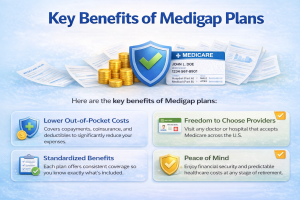
Key benefits of Medigap coverage

Help Paying Medicare Costs

If your income and savings are limited, two programs can cut your Medicare costs sharply:

Medicare Savings Programs

✔

Run by your state Medicaid office

✔

Can pay your Part B premium, and sometimes deductibles and coinsurance

✔

Income and asset limits vary by state

Extra Help (Part D)

✔

Run by Social Security

✔

Lowers Part D premiums, deductibles and copays

✔

People in a Medicare Savings Program qualify automatically

Those who are eligible for Medicare along with full Medicaid might also have the option of enrolling in a Dual Special Needs Plan. Learn more about help for low-income Part D beneficiaries.

What Original Medicare Leaves You to Pay

A Medicare Supplement plan is built to cover the gaps in Original Medicare. These are the costs it can pick up:

Original Medicare Gap What It Means for You Covered By
Part A deductible A deductible for each hospital benefit period, not once a year. It was $1,736 in 2026. Plans B, C, D, F, G and N in full; K, L and M in part
Part A hospital coinsurance Daily charges after day 60 of a hospital stay, rising after day 90 All 10 plans, plus 365 extra hospital days
Part B deductible A yearly deductible before Part B pays. It was $283 in 2026. Only Plans C and F
Part B coinsurance Usually 20% of the approved amount, with no yearly cap All plans (K and L in part, N with copays)
Part B excess charges Up to 15% above the approved amount from doctors who do not take assignment Plans F and G
Skilled nursing coinsurance Daily charges from day 21 to day 100 of a covered stay Plans C, D, F, G, M and N (K and L in part)
Emergency care abroad Original Medicare generally does not cover care outside the U.S. Plans C, D, F, G, M and N, up to plan limits

No cap without a supplement: Original Medicare has no out-of-pocket maximum. Without a Medigap plan or other coverage, there is no limit to the 20% you can owe on Part B services.

All 10 Medigap Plans Compared

Federal law sets exactly what each plan letter covers, so the same letter has the same benefits from every insurer in your state.

Benefit A B C* D F* G K L M N
Part A coinsurance and hospital costs up to 365 extra days Yes Yes Yes Yes Yes Yes Yes Yes Yes Yes
Part B coinsurance or copayment Yes Yes Yes Yes Yes Yes 50% 75% Yes Yes***
First 3 pints of blood Yes Yes Yes Yes Yes Yes 50% 75% Yes Yes
Part A hospice coinsurance or copayment Yes Yes Yes Yes Yes Yes 50% 75% Yes Yes
Skilled nursing facility coinsurance No No Yes Yes Yes Yes 50% 75% Yes Yes
Part A deductible No Yes Yes Yes Yes Yes 50% 75% 50% Yes
Part B deductible No No Yes No Yes No No No No No
Part B excess charges No No No No Yes Yes No No No No
Foreign travel emergency (up to plan limits) No No 80% 80% 80% 80% No No 80% 80%
Out-of-pocket limit None None None None None None Yes** Yes** None None

*Plans C and F can only be bought by people who were eligible for Medicare before January 1, 2020. **Plans K and L have a yearly out-of-pocket limit that Medicare sets each year; after you reach it, the plan pays 100% of covered services for the rest of the year. ***Plan N pays all Part B coinsurance except copays of up to $20 for some office visits and up to $50 for emergency room visits that do not lead to an inpatient admission. Massachusetts, Minnesota and Wisconsin standardize their plans differently.

Plan G, Plan N and High-Deductible Plan G

These three are the usual picks for people just starting on Medicare. With Plan G, every gap is covered apart from the Part B deductible. Plan N charges a smaller premium in exchange for copays as high as $20 for certain office visits and as high as $50 for ER trips that do not end in admission, and it leaves Part B excess charges uncovered. For 2027, High-Deductible Plan G carries a $3,050 deductible, rising from $2,950, after which it pays like Plan G. Read Plan G vs Plan N.

Plan G

✔

You pay the Part B deductible, then little or nothing

✔

Covers Part B excess charges

✔

Highest premium of the three

Plan N

✔

You pay the Part B deductible plus small copays

✔

Does not cover Part B excess charges

✔

Usually a lower premium than Plan G

High-Deductible G

✔

You pay up to $3,050 in 2027 before coverage starts

✔

Then covers like Plan G

✔

Lowest premium

How Medigap Prices Are Set

Your Age

Many insurers charge more as you get older.

Your ZIP Code

Prices vary by state and area.

Tobacco Use

Tobacco users usually pay more.

Discounts

Household or other discounts, depending on the insurer and state.

Pricing Method How the Premium Is Set Over Time
Community-rated Everyone in an area pays the same premium, regardless of age Does not rise because you get older, but can rise for inflation and other reasons
Issue-age-rated Based on your age when you buy Does not rise because you get older, but can rise for other reasons
Attained-age-rated Based on your current age Rises as you age, on top of other increases

The method depends on the insurer and the state. Ask how a policy is priced before you buy, not just what it costs today.

What Medigap Does Not Cover

Not Covered by Medigap

✔

Prescription drugs: add a standalone Part D plan

✔

Routine dental care, eye exams for glasses, and hearing aids

✔

Long-term custodial care in a nursing home or at home

✔

Private-duty nursing

For 2027, a standalone Part D plan has a maximum deductible of $700 and an out-of-pocket cap of $2,400. Buy one when you buy Medigap to avoid a lifelong late enrollment penalty.

Medigap vs Medicare Advantage

Medicare Advantage Original Medicare + Medigap
Monthly premium Often low or $0 (2027 average $12, CMS) Higher; varies by plan letter, age and ZIP
Doctors Usually a network Any provider in the U.S. that accepts Medicare
Costs when you get care Copays and coinsurance up to a yearly maximum Low and predictable; little or nothing on Plan G after the Part B deductible
Drug coverage Usually included Add a separate Part D plan
Dental, vision, hearing Many plans may include some coverage Not included
Changing later Every year during Annual Enrollment Health questions in most states after your Medigap Open Enrollment Period

Plans K and L: Lower Premiums With a Cost Cap

Plans K and L pay a share of most costs instead of all of them: Plan K pays 50% and Plan L pays 75% of most cost sharing, after which you pay the rest. In exchange for lower premiums, both have a yearly out-of-pocket limit that Medicare sets each year. Once you reach it, the plan pays 100% of covered services for the rest of the year.

These plans can suit people who want catastrophic protection at a lower premium and can handle some costs along the way. Ask whether your insurer offers Plan K or L in your state.

Plans C and F for Earlier Enrollees

Plans C and F are the only plans that cover the Part B deductible. Since January 1, 2020, they cannot be sold to people newly eligible for Medicare. If you were eligible for Medicare before that date, even if you did not enroll, you may still be able to buy Plan C or F, including a High-Deductible Plan F with the same $3,050 deductible for 2027.

For most people who can buy either, compare the yearly premium difference between Plan F and Plan G with the Part B deductible. If Plan F costs more than the deductible saves you, Plan G is the better value.

Medigap Under 65

If you have Medicare before 65 because of a disability or end-stage renal disease, federal law does not require insurers to sell you a Medigap policy, but many states do. Prices for people under 65 can be much higher, and plan choices may be limited. When you turn 65, you get a new six-month Medigap Open Enrollment Period, when you can buy any plan sold in your state at the same prices as everyone else your age.

Medigap When You Travel

Inside the U.S., a Medigap plan follows you everywhere, because it works with any provider that accepts Medicare. Outside the U.S., Original Medicare generally pays nothing, but Plans C, D, F, G, M and N cover 80% of emergency care abroad after a $250 yearly deductible, up to a $50,000 lifetime limit.

Rate Increases and Switching Insurers Later

Medigap benefits never change once you buy, but premiums can. Insurers file rate increases with state regulators, often once a year. Because the same plan letter covers the same benefits everywhere, switching to a lower-priced insurer can save money without changing your coverage.

The catch is underwriting. Outside your Medigap Open Enrollment Period or a guaranteed issue situation, most states let the new insurer ask health questions and decline you. Never cancel your current policy until the new one is approved and in force.

How Medigap Claims Work

In most cases you never file a Medigap claim. Your doctor bills Medicare, Medicare pays its share, and the claim crosses over to your Medigap insurer automatically, which pays its share. You get a Medicare Summary Notice and an explanation of benefits showing what each paid.

Medigap and Part D Together

Because Medigap plans sold today do not cover prescriptions, you should also have a Part D plan. It does not have to come from your Medigap company. Choose it by your drugs and pharmacy in Medicare Plan Finder, and review it every fall. If you delay drug coverage without other creditable coverage, the late penalty adds 1% of the national base beneficiary premium, $41.33 for 2027, for every month you went without.

Turning 65 in 2027

If you turn 65 in 2027, your Initial Enrollment Period lasts seven months: the three months before your birthday month, your birthday month and the three months after. Signing up during the first three months means your coverage starts on the first day of your birthday month.

Turning 65 Checklist

✔

Sign up for Part A and Part B, unless you have qualifying employer coverage and choose to delay Part B

✔

Decide between Medicare Advantage and Original Medicare with Medigap

✔

Join a drug plan, or a Medicare Advantage plan with drugs, to avoid a Part D late penalty

✔

If you choose Medigap, buy during your six-month Medigap Open Enrollment Period

Excess Charges and Medicare Assignment

Doctors who “accept assignment” agree to take Medicare’s approved amount as full payment. Doctors who do not accept assignment can charge up to 15% more, called a Part B excess charge. Plans F and G cover excess charges; Plan N and most other plans do not.

Most doctors accept assignment, and some states limit or prohibit excess charges, so for many people the risk is small. Ask your doctors whether they accept assignment before deciding whether excess charge coverage is worth paying for.

Getting Help

You do not have to compare plans alone, and you should not have to pay for help. These are the free options:

Free Help Comparing Plans

✔

Medicare Plan Finder on Medicare.gov, available any time

✔

1-800-MEDICARE (1-800-633-4227), available 24 hours a day, seven days a week

✔

Your State Health Insurance Assistance Program (SHIP), which offers free, unbiased counseling

✔

A licensed insurance agent or broker, who can compare plans from several insurers at no cost to you

Before any call, have your Medicare card, your list of drugs and doses, your doctors and your preferred pharmacies ready. It turns a long conversation into a short one.

Bottom Line

The Bottom Line

Seniors choose Medigap for freedom and predictability; buy it during open enrollment to lock in that choice.

Compare plans and enroll online

Frequently Asked Questions

➤ Why do some seniors choose Medigap?

For the freedom to see any provider in the U.S. that accepts Medicare, predictable out-of-pocket costs, and no referrals or networks. Many people with ongoing health needs or who travel value that certainty over lower premiums.

➤ Is Medigap better than Medicare Advantage?

It depends on your needs. Medigap offers freedom and predictable costs at a higher premium, while Medicare Advantage has lower premiums, networks and extras. People who want any-doctor access or expect heavy care use often prefer Medigap.

➤ What is the most popular Medigap plan?

Plan G is a popular choice for new enrollees because it covers everything Plan F does except the Part B deductible. Plan N is a lower-premium option with small copays. Plan F is only for those eligible before 2020.

➤ Does Medigap cover prescriptions?

No. Medigap does not include drug coverage, so you add a separate Part D plan. For 2027 the maximum Part D deductible is $700 and the out-of-pocket cap on covered drugs is $2,400; enroll in both on time.

➤ Does Medigap work in every state?

Yes. A Medigap policy works with any provider in the U.S. that accepts Medicare, no matter where you bought it. That makes it a common choice for snowbirds and people who visit family in other states.

➤ When is the best time to buy Medigap?

During your six-month Medigap Open Enrollment Period, which starts the first month you are 65 or older and enrolled in Part B. Insurers cannot deny you or charge more for health conditions during that window.

➤ Can a Medigap policy be canceled because of my health?

No. Medigap policies are guaranteed renewable, so the insurer cannot cancel your policy because of health problems as long as you pay your premiums. Premiums can still rise over time, depending on the pricing method.

➤ Does Medigap cover dental or vision?

No. Medigap does not cover routine dental, routine vision, eyeglasses or hearing aids. Many people who choose Medigap buy a standalone dental or vision policy to fill those gaps; compare premiums, waiting periods and annual maximums before buying one.

➤ Do Medigap plans cover travel outside the U.S.?

Plans C, D, F, G, M and N include a foreign travel emergency benefit that pays 80% of emergency care after a $250 deductible, up to $50,000 lifetime. Plans A, B, K and L do not include it.


Have Questions?

Speak with a licensed insurance agent

1-855-398-0716

TTY users 711

Mon-Fri: 8am-9pm ET

Find & Compare Plans Online

Speak with a licensed insurance agent

1-855-398-0716TTY 711

Mon-Fri: 8am-9pm ET

ZRN Health & Financial Services, LLC, a Texas limited liability company