Speak with a licensed insurance agent

1-855-398-0716

TTY user 711 Mon-Fri : 8am-9pm EST

Preventative Dental Care for Seniors

Reviewed by Russell Noga, Licensed Medicare Insurance Broker (all 50 states) — Last updated November 18, 2026

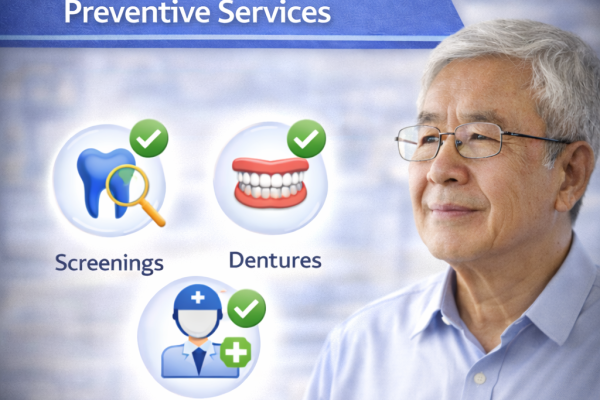
Preventive dental care for seniors means regular exams, professional cleanings, X-rays and oral cancer checks, plus daily care at home. Original Medicare does not pay for routine preventive dental visits, but many Medicare Advantage plans and standalone dental policies may cover them.

Prevention matters more with age: many medications cause dry mouth, gums recede, and older fillings and crowns wear out. Catching problems early usually costs far less than treating them later, which is why most dental plans cover preventive care better than any other service.

See why dental health is important for older adults.

✔ Licensed in all 50 states
✔ Based on CMS 2027 data
✔ Free plan comparison

Key Highlights

✔

Exams, cleanings and X-rays.

✔

Original Medicare does not cover routine visits.

✔

Many plans may cover prevention well.

✔

Early care costs less.

Compare plans and enroll online

What Preventive Dental Care Includes

Service Why It Matters How Plans Often Treat It
Oral exam Finds decay, gum disease and worn dental work early Usually covered at the highest level
Professional cleaning Removes buildup that home brushing misses Often limited to a set number per year
X-rays Shows decay between teeth and below the gumline Frequency limits are common
Oral cancer screening Part of many routine exams Usually included with the exam
Fluoride or sealants Can protect weakened enamel and exposed roots Coverage for adults varies

Why Prevention Matters More After 65

Common Changes With Age

✔

Dry mouth from common medications raises the risk of decay

✔

Receding gums expose roots that decay more easily

✔

Older fillings and crowns can crack or leak

✔

Gum disease can progress without pain

✔

Dentures and partials need regular fit checks

Because many of these problems develop quietly, the routine visit is often the only time they are caught while treatment is still simple.

Understanding the Importance of Dental Care for Seniors

Find & Compare Plans Online

Speak with a licensed insurance agent

1-855-398-0716TTY 711

Mon-Fri: 8am-9pm ET

How Preventive Dental Care Is Covered With Medicare

Coverage Source Preventive Dental Care
Original Medicare Not covered
Medigap Not covered
Medicare Advantage Many plans may include exams, cleanings and X-rays
Standalone dental insurance Usually covered with few or no waiting periods
Dental discount plan Reduced fees, not insurance

Not all plans offer all benefits. Benefits vary by plan and county.

A Simple Prevention Routine

At Home and at the Dentist

1

Brush twice a day with fluoride toothpaste. Use a soft brush, and consider an electric brush if grip is difficult.

2

Clean between teeth daily. Floss, picks or a water flosser all work.

3

Manage dry mouth. Ask your doctor or dentist about medications that cause it.

4

Clean dentures every day. Remove them overnight unless your dentist says otherwise.

5

Keep your routine visits. Use every preventive visit your plan covers.

Remember: Original Medicare does not cover routine dental care such as cleanings, fillings, extractions or dentures, and Medigap does not fill that gap. Dental coverage has to come from a Medicare Advantage plan that may include it, a separate dental policy or another program.

How Medicare Advantage Works

Medicare Advantage, also called Part C, is a way to get your Medicare benefits through a private insurance company approved by Medicare. The plan covers everything Original Medicare Part A and Part B cover, except hospice care, which Original Medicare still pays. Most plans also include Part D drug coverage, and many may add extras such as routine dental, vision and hearing benefits.

In exchange, Medicare Advantage plans generally use networks of doctors and hospitals, and may require referrals or prior authorization for some services. Every Medicare Advantage plan has a yearly out-of-pocket maximum for covered medical care, which Original Medicare does not have. You keep paying your Part B premium, plus your plan’s premium if it has one.

Feature HMO PPO
Out-of-network care Not covered except emergencies and urgent care Covered at a higher cost
Referrals for specialists Usually required Usually not required
Premiums Usually lower Usually higher
Out-of-pocket maximum In-network limit In-network limit plus a higher combined limit
Best for Lower costs, local care Flexibility, travel, keeping specific doctors
Role of Disease Prevention in Dental Health

Benefits Plans May Include

Medicare Advantage Plans May Include

✔

Hospital and medical coverage, the same as Original Medicare Part A and B

✔

Part D prescription drug coverage on most plans

✔

Routine dental, vision and hearing benefits

✔

Fitness programs and over-the-counter allowances

✔

Telehealth visits and care coordination programs

✔

A yearly out-of-pocket maximum on every plan

Not all plans offer all benefits. Benefits vary by plan and county and can change for 2027. Check each plan’s Evidence of Coverage before you enroll.

How to Compare

How to Compare

1

Read your Annual Notice of Change. It lists every change to your current plan for 2027.

2

Check your doctors and hospitals. Confirm each provider is in the 2027 network, not just the 2026 one.

3

Check your prescriptions. Confirm each drug, its tier and any prior authorization or step therapy rules.

4

Compare total yearly cost. Add the premium, typical copays and drug costs, and look at the out-of-pocket maximum.

5

Check star ratings. Medicare rates plans from 1 to 5 stars on quality and service.

6

Enroll by December 7. Your new coverage starts January 1, 2027.

Enrollment Periods

Enrollment Period Dates What You Can Do
Annual Enrollment Period October 15 to December 7, 2026 Join, switch or drop a Medicare Advantage or Part D plan for January 1, 2027
Medicare Advantage Open Enrollment January 1 to March 31, 2027 If you are in Medicare Advantage, switch to another plan or return to Original Medicare once
Initial Enrollment Period 7 months around your 65th birthday month Sign up for Medicare and choose your first plan
Special Enrollment Periods Varies Change plans after events like moving, losing other coverage or your plan leaving your area

Most people make changes during Annual Enrollment. If you are happy with your current plan, you do not have to do anything; it renews automatically. Still, read your Annual Notice of Change, because premiums, copays, networks and drug lists can all change on January 1.

Help Paying Medicare Costs

If your income and savings are limited, two programs can cut your Medicare costs sharply:

Medicare Savings Programs

✔

Run by your state Medicaid office

✔

Can pay your Part B premium, and sometimes deductibles and coinsurance

✔

Income and asset limits vary by state

Extra Help (Part D)

✔

Run by Social Security

✔

Lowers Part D premiums, deductibles and copays

✔

People in a Medicare Savings Program qualify automatically

Those who are eligible for Medicare along with full Medicaid might also have the option of enrolling in a Dual Special Needs Plan. Learn more about help for low-income Part D beneficiaries.

Reading Your Annual Notice of Change

Check Every Line

✔

Your 2027 premium and deductible

✔

Copays for doctors, specialists and hospital stays

✔

The out-of-pocket maximum

✔

Updates to your formulary, drug tiers and coverage requirements

✔

Whether your doctors, hospitals and pharmacy are still in network

✔

Changes to dental, vision, hearing and other extras

Plans must send the Annual Notice of Change by September 30. It is the single most useful document you get each fall, because it tells you exactly how your plan changes on January 1.

Special Enrollment Periods

Outside the fall and early-year windows, you generally need a Special Enrollment Period to change plans. Common reasons include:

You May Qualify If

✔

Your plan is leaving your area or ending

✔

You move outside your plan’s service area

✔

You lose employer or union coverage

✔

You qualify for Extra Help or a Medicare Savings Program, or your Medicaid status changes

✔

You want to join a 5-star plan, once a year

Each Special Enrollment Period has its own time limit, so act as soon as the event happens.

Prior Authorization and Referrals

Most Medicare Advantage plans require prior authorization for some services, such as certain surgeries, advanced imaging, skilled nursing stays and some drugs. Your doctor usually requests it, but ask whether a planned service needs approval so a denial does not surprise you.

If a request is denied, you or your doctor can appeal. Medicare rules set deadlines for plans to decide, with faster deadlines when waiting could seriously harm your health.

Emergency, Urgent and Out-of-Area Care

Every Medicare Advantage plan covers emergency care and urgent care anywhere in the U.S., in or out of network, and you do not need prior approval for an emergency. Routine care away from home is a different story: HMOs generally do not cover it, while PPOs cover out-of-network care at a higher cost.

If you spend months away from home each year, ask each plan how it handles care in your second location. It is one of the most common reasons people switch plans mid-year.

Appeals and Complaints

If your plan denies a service, a drug or payment for care, you have the right to appeal. The plan’s denial notice explains how. There are several levels of appeal, starting with the plan and moving to independent reviewers.

For problems that are not about coverage, such as customer service or wait times, you can file a grievance with the plan. You can also contact 1-800-MEDICARE or your State Health Insurance Assistance Program for help.

The 2027 Part B Premium

The Part B premium was the one big number not released with the plans. CMS announced it on November 17, 2026: a 2027 standard premium of $209.40 a month and a deductible of $292, up from $202.90 and $283 in 2026. You keep paying it with Medicare Advantage.

If You Miss December 7

If you miss the Annual Enrollment deadline, your current plan renews automatically for 2027, with the changes in your Annual Notice of Change. If you are in Medicare Advantage, you get one more chance from January 1 to March 31, 2027, to switch Medicare Advantage plans or return to Original Medicare and join a Part D plan.

Telehealth

Many Medicare Advantage plans may cover telehealth visits for some services, sometimes at a lower copay than an office visit. Telehealth is convenient for follow-ups and minor issues, but it does not replace confirming that your regular doctors are in network.

Pros and Cons of Medicare Advantage

Advantages

✔

Often a low or $0 premium

✔

A yearly out-of-pocket maximum

✔

Drug coverage usually included

✔

Many plans may include dental, vision and hearing benefits

✔

One card and one plan

Tradeoffs

✔

Networks; HMOs require in-network care except emergencies

✔

Prior authorization and referrals are common

✔

Copays add up if you use a lot of care

✔

Plans and networks can change every year

✔

Switching to Medigap later may require health questions

Special Needs Plans

Special Needs Plans (SNPs) are Medicare Advantage plans built for specific groups. Benefits, networks and drug lists are designed around the members they serve, and many include care coordinators. For 2027, Special Needs Plans are one of the few areas where large insurers are adding plans, even as they cut PPOs.

Type Who Qualifies What Is Different
Dual Special Needs Plan (D-SNP) People with both Medicare and Medicaid Coordinates both programs; often very low costs and added benefits
Chronic Condition SNP (C-SNP) People with qualifying conditions such as diabetes, heart failure or chronic lung disease Doctors, drugs and programs built around the condition
Institutional SNP (I-SNP) People living in a nursing home or who need that level of care at home Care delivered where the member lives

Getting Help

You do not have to compare plans alone, and you should not have to pay for help. These are the free options:

Free Help Comparing Plans

✔

Medicare Plan Finder on Medicare.gov, available any time

✔

1-800-MEDICARE (1-800-633-4227), available 24 hours a day, seven days a week

✔

Your State Health Insurance Assistance Program (SHIP), which offers free, unbiased counseling

✔

A licensed insurance agent or broker, who can compare plans from several insurers at no cost to you

Before any call, have your Medicare card, your list of drugs and doses, your doctors and your preferred pharmacies ready. It turns a long conversation into a short one.

Bottom Line

The Bottom Line

Use every preventive visit your coverage allows. If you have Original Medicare, add dental coverage or compare Medicare Advantage plans that may include it.

Compare plans and enroll online

Frequently Asked Questions

➤ Does Medicare cover preventive dental care?

No, Original Medicare does not cover routine preventive dental care such as exams, cleanings and X-rays. Many Medicare Advantage plans may include these services, and standalone dental insurance usually covers them. Not all plans offer all benefits, so check what each plan includes.

➤ How often should seniors see the dentist?

Most seniors benefit from a routine exam and cleaning on the schedule their dentist recommends, often about twice a year. People with gum disease, dry mouth or dentures may need different timing. Check how many preventive visits your plan covers each year.

➤ What is included in a preventive dental visit?

A preventive visit usually includes an oral exam, a professional cleaning and X-rays when needed. Many dentists also check for oral cancer and look at the fit of dentures or partials. Plans often cover these services better than any other dental care.

➤ Why is preventive dental care important for older adults?

Preventive care catches problems while they are still simple and inexpensive. Seniors face more dry mouth, receding gums and worn dental work, and gum disease can progress without pain. Regular visits often prevent costly fillings, crowns or extractions later.

➤ Do Medicare Advantage plans cover dental cleanings?

Many Medicare Advantage plans may include routine cleanings, often with a limit on how many per year. Benefits vary by plan and county, and not all plans offer dental. Check the plan’s Evidence of Coverage and dental network before you enroll.

➤ Does standalone dental insurance cover preventive care right away?

Many standalone dental policies cover preventive care with little or no waiting period, while basic and major services may have waiting periods. Read the policy to confirm the rules, the number of covered visits and the annual maximum before you buy.

➤ Does Medigap cover dental cleanings?

No. Medigap only pays toward services that Original Medicare covers, and routine dental care is not one of them. If you have a Medigap plan and want preventive dental coverage, add a standalone dental policy or use a dental discount plan.

➤ How can seniors with dry mouth protect their teeth?

Seniors with dry mouth can sip water often, limit sugary drinks and ask their doctor whether a medication is the cause. Fluoride toothpaste and regular cleanings help protect teeth, and a dentist may suggest added fluoride treatments.

➤ Is preventive dental care worth paying for out of pocket?

For most seniors, yes. Routine exams and cleanings usually cost far less than the fillings, root canals or extractions they help prevent. If you pay out of pocket, ask about cash prices or a dental discount plan.

➤ When can I join a Medicare Advantage plan with dental benefits?

You can join or switch during Annual Enrollment, October 15 to December 7, 2026, for coverage starting January 1, 2027. If you are already in Medicare Advantage, you can also make one change from January 1 to March 31, 2027.


Have Questions?

Speak with a licensed insurance agent

1-855-398-0716

TTY users 711

Mon-Fri: 8am-9pm ET

Find & Compare Plans Online

Speak with a licensed insurance agent

1-855-398-0716TTY 711

Mon-Fri: 8am-9pm ET

ZRN Health & Financial Services, LLC, a Texas limited liability company