Speak with a licensed insurance agent

1-855-398-0716

TTY user 711 Mon-Fri : 8am-9pm EST

Medicare Part D

Reviewed by Russell Noga, Licensed Medicare Insurance Broker (all 50 states) — Last updated October 8, 2026

Medicare Part D is Medicare’s prescription drug benefit, sold by private insurers as standalone drug plans or as part of Medicare Advantage plans. For 2027, Part D has a maximum deductible of $700 and an out-of-pocket cap of $2,400.

Original Medicare does not cover most prescriptions you fill at a pharmacy. Part D fills that gap. You choose a plan, pay its premium, and use its formulary and pharmacy network. Because every plan covers drugs differently, the right plan depends on exactly which drugs you take.

This guide explains how Part D works, what it covers and costs, when to enroll, how to avoid the late penalty, and how to choose. For 2027 plan comparisons, see Medicare Part D plans 2027 and the 2027 Part D plan finder.

✔ Licensed in all 50 states
✔ Based on CMS 2027 data
✔ Free plan comparison

Key Highlights

✔

Part D covers outpatient prescription drugs through private plans approved by Medicare.

✔

For 2027, the maximum deductible is $700 and the out-of-pocket cap is $2,400.

✔

The average standalone Part D premium is about $36 a month for 2027 (CMS).

✔

Going without creditable drug coverage can mean a lifelong late enrollment penalty.

✔

People with limited income may qualify for Extra Help.

Compare plans and enroll online

What Is Medicare Part D?

Part D was created in 2006 to give people with Medicare access to prescription drug coverage. It is voluntary, but most people should have it or other creditable coverage from the time they are first eligible.

Standalone Part D Plan

✔

Works with Original Medicare, alone or with Medigap

✔

Average about $36 a month for 2027

✔

Choose any plan offered in your region

✔

Medical care stays with Original Medicare

Medicare Advantage With Drugs

✔

Drug coverage built into your health plan

✔

Drug portion averages about $7 a month for 2027

✔

One card and one plan for medical and drugs

✔

You generally use the plan’s network for medical care

What Part D Covers

Every Part D plan must cover a wide range of drugs in commonly used categories, and all or substantially all drugs in six protected classes: antidepressants, antipsychotics, anticonvulsants, immunosuppressants for transplants, cancer drugs and HIV/AIDS drugs. Covered insulin costs no more than $35 a month, and CDC-recommended adult vaccines covered by Part D cost $0.

Each plan has its own formulary. Always check that your specific drugs are covered.

What is Medicare Part D

How Part D Coverage Works

The Three Stages

1

Deductible stage. You pay the full negotiated price until you meet your plan’s deductible, up to $700 in 2027.

2

Initial coverage stage. You pay a copay or coinsurance by tier; the plan pays the rest.

3

Catastrophic stage. After $2,400 in out-of-pocket costs, covered drugs cost $0 for the rest of 2027.

$700

Maximum 2027 Part D deductible, up from $615.

$2,400

2027 Part D out-of-pocket cap, up from $2,100.

About $36

Average 2027 standalone Part D premium, up less than $1 (CMS).

$7

Projected average drug portion of a Medicare Advantage premium for 2027, down from $11.32.

If big drug costs hit early in the year, the Medicare Prescription Payment Plan lets you spread your out-of-pocket drug costs into monthly payments across the year instead of paying at the pharmacy counter. It is available with every Part D plan and Medicare Advantage plan with drug coverage, and it does not change the total you owe.

Find & Compare Plans Online

Speak with a licensed insurance agent

1-855-398-0716TTY 711

Mon-Fri: 8am-9pm ET

Drug Tiers and Coverage Rules

Tier Typical Drugs Typical Cost
Tier 1 Preferred generics Lowest copay
Tier 2 Generics Low copay
Tier 3 Preferred brand-name drugs Moderate copay
Tier 4 Non-preferred drugs Higher copay or coinsurance
Tier 5 Specialty drugs Highest coinsurance

Tier structures vary by plan. Check each plan’s formulary.

Plans can require prior authorization, step therapy or quantity limits. If your doctor believes you need a drug that is restricted or not covered, you can request an exception.

Preferred Pharmacies and Mail Order

Where you fill prescriptions can change your yearly cost as much as which plan you choose. Most plans divide their network into preferred and standard pharmacies. Preferred pharmacies have lower negotiated prices and often lower copays; standard pharmacies are still in network but usually cost more. Out-of-network pharmacies are generally not covered except in limited situations.

Retail Pharmacy

✔

Pick up the same day

✔

Pharmacist on hand for questions

✔

Preferred retail pharmacies keep copays low

Mail Order

✔

90-day supplies of maintenance drugs

✔

Often the lowest copay for long-term medicines

✔

Delivered to your home

If you take maintenance drugs for blood pressure, cholesterol, diabetes or thyroid, compare a 90-day mail-order fill in the plan finder. For many people it is the single easiest way to cut costs.

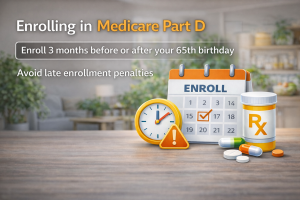
Enrolling in Medicare Part D

Who Needs Part D

Your Situation What to Do
Original Medicare only Join a standalone Part D plan
Original Medicare and Medigap Join a standalone Part D plan; Medigap does not cover drugs
Medicare Advantage with drug coverage Drug coverage is included; do not add a separate Part D plan
Employer or union coverage Ask whether it is creditable; if so, you can delay Part D without a penalty
VA or TRICARE drug coverage Generally creditable; check before adding Part D

When to Enroll

Enrollment Period Dates What You Can Do
Annual Enrollment Period October 15 to December 7, 2026 Join, switch or drop a Medicare Advantage or Part D plan for January 1, 2027
Medicare Advantage Open Enrollment January 1 to March 31, 2027 If you are in Medicare Advantage, switch to another plan or return to Original Medicare once
Initial Enrollment Period 7 months around your 65th birthday month Sign up for Medicare and choose your first plan
Special Enrollment Periods Varies Change plans after events like moving, losing other coverage or your plan leaving your area

Most people make changes during Annual Enrollment. If you are happy with your current plan, you do not have to do anything; it renews automatically. Still, read your Annual Notice of Change, because premiums, copays, networks and drug lists can all change on January 1. You first become eligible for Part D during your Initial Enrollment Period around your 65th birthday.

The Late Enrollment Penalty

Late enrollment penalty: if you go 63 days or more in a row without Part D or other creditable drug coverage after your Initial Enrollment Period, Medicare adds 1% of the national base beneficiary premium for each full month you went without. The 2027 base beneficiary premium is $41.33, so every uncovered month adds about $0.41 a month, for as long as you have Part D.

The penalty is permanent: it is added to your premium for as long as you have Part D. The simplest way to avoid it is to join a plan when you are first eligible, even a low-cost plan if you take few drugs today.

Help Paying for Drugs

Extra Help: people with limited income and resources may qualify for Extra Help, which lowers Part D premiums, deductibles and copays. People enrolled in a Medicare Savings Program automatically qualify. See Extra Help and prescription assistance programs.

Medicare Savings Programs

✔

Run by your state Medicaid office

✔

Can pay your Part B premium, and sometimes deductibles and coinsurance

✔

Income and asset limits vary by state

Extra Help (Part D)

✔

Run by Social Security

✔

Lowers Part D premiums, deductibles and copays

✔

People in a Medicare Savings Program qualify automatically

If you qualify for both Medicare and full Medicaid, you may also be able to join a Dual Special Needs Plan. See help for low-income Part D beneficiaries.

If a Drug Is Not Covered

Sometimes a drug you take is not on a plan’s 2027 formulary, or it carries a rule like prior authorization. You still have options:

If Your Drug Is Not Covered

1

Ask for a transition fill. In the first 90 days of a new plan year or a new plan, plans generally must give you a temporary supply of a drug you were already taking, so you have time to switch or request an exception.

2

Ask your doctor about alternatives. A covered drug in the same class may work as well and cost less.

3

Request a formulary or tiering exception. Your doctor submits a statement explaining why you need the drug or a lower copay. Plans must decide within set time limits.

4

Appeal a denial. If the plan says no, you can appeal, and there are several levels of review.

See steps to appeal a Medicare Part D denial.

How to Choose a Part D Plan

Step by Step

1

List every prescription. Dose and how often you fill it.

2

Enter them in Medicare Plan Finder. Add your pharmacies.

3

Sort by total yearly cost. Premium plus drug costs.

4

Check tiers and rules. Prior authorization and step therapy.

5

Confirm pharmacy status. Preferred usually costs less.

6

Review every fall. Plans change each January.

Standard vs Enhanced Plans

A basic plan covers at least Medicare’s standard benefit; an enhanced plan adds coverage such as a lower deductible, usually for a higher premium. For 2027, CMS says 88% of non-low-income beneficiaries can get a basic plan for $10.30 a month or less, and 93% can get an enhanced plan for less than $6. See standard vs enhanced Part D plans.

Reading Your Annual Notice of Change

Check Every Line

✔

Your 2027 premium and deductible

✔

Copays for doctors, specialists and hospital stays

✔

The out-of-pocket maximum

✔

Changes to your drug list, tiers and coverage rules

✔

Whether your doctors, hospitals and pharmacy are still in network

✔

Changes to dental, vision, hearing and other extras

Plans must send the Annual Notice of Change by September 30. It is the single most useful document you get each fall, because it tells you exactly how your plan changes on January 1.

Special Enrollment Periods

Outside the fall and early-year windows, you generally need a Special Enrollment Period to change plans. Common reasons include:

You May Qualify If

✔

Your plan is leaving your area or ending

✔

You move outside your plan’s service area

✔

You lose employer or union coverage

✔

You qualify for Extra Help or a Medicare Savings Program, or your Medicaid status changes

✔

You want to join a 5-star plan, once a year

Each Special Enrollment Period has its own time limit, so act as soon as the event happens.

Common Part D Mistakes

Avoid These

1

Choosing by premium alone. Total yearly cost is what matters.

2

Leaving drugs off your list. One missing drug can change the winner.

3

Ignoring pharmacy status. Standard pharmacies can cost much more.

4

Auto-renewing without checking. Formularies and tiers change every January.

5

Delaying without creditable coverage. The penalty lasts as long as you have Part D.

How 2027 Part D Premiums Are Set

Each Part D plan submits a bid to CMS. CMS uses the bids to set the national average monthly bid amount, $296.05 for 2027, and the base beneficiary premium, $41.33 for 2027. The base premium is used to calculate the late penalty and subsidies; your actual premium depends on your plan and region. Federal law limits base premium growth to 6% a year through 2029.

Standard vs Enhanced Part D Plans

A basic plan covers at least Medicare’s standard benefit. An enhanced plan adds coverage, such as a lower deductible or lower copays, usually for a higher premium. For 2027, CMS says 88% of non-low-income beneficiaries can get a basic plan for $10.30 a month or less, and 93% can get an enhanced plan for less than $6.

Turning 65 in 2027

If you turn 65 in 2027, your Initial Enrollment Period lasts seven months: the three months before your birthday month, your birthday month and the three months after. Signing up during the first three months means your coverage starts on the first day of your birthday month.

Turning 65 Checklist

✔

Sign up for Part A and Part B, unless you have qualifying employer coverage and choose to delay Part B

✔

Decide between Medicare Advantage and Original Medicare with Medigap

✔

Join a drug plan, or a Medicare Advantage plan with drugs, to avoid a Part D late penalty

✔

If you choose Medigap, buy during your six-month Medigap Open Enrollment Period

Medicare Advantage or Medigap?

Medicare Advantage Original Medicare + Medigap
Monthly premium Often low or $0 (2027 average $12, CMS) Higher; varies by plan letter, age and ZIP
Doctors Usually a network Any provider in the U.S. that accepts Medicare
Costs when you get care Copays and coinsurance up to a yearly maximum Low and predictable; little or nothing on Plan G after the Part B deductible
Drug coverage Usually included Add a separate Part D plan
Dental, vision, hearing Many plans may include some coverage Not included
Changing later Every year during Annual Enrollment Health questions in most states after your Medigap Open Enrollment Period

Appeals and Complaints

If your plan denies a service, a drug or payment for care, you have the right to appeal. The plan’s denial notice explains how. There are several levels of appeal, starting with the plan and moving to independent reviewers.

For problems that are not about coverage, such as customer service or wait times, you can file a grievance with the plan. You can also contact 1-800-MEDICARE or your State Health Insurance Assistance Program for help.

The 2027 Part B Premium

The Part B premium is the one big number not released with the plans. CMS normally announces it in November. The 2026 Medicare Trustees Report projects a 2027 standard premium of about $209.50 a month and a deductible of about $292, up from $202.90 and $283 in 2026. You keep paying it with Medicare Advantage.

If You Miss December 7

If you miss the Annual Enrollment deadline, your current plan renews automatically for 2027, with the changes in your Annual Notice of Change. If you are in Medicare Advantage, you get one more chance from January 1 to March 31, 2027, to switch Medicare Advantage plans or return to Original Medicare and join a Part D plan.

Medigap and Part D Together

Because Medigap plans sold today do not cover prescriptions, you should also have a Part D plan. It does not have to come from your Medigap company. Choose it by your drugs and pharmacy in Medicare Plan Finder, and review it every fall. If you delay drug coverage without other creditable coverage, the late penalty adds 1% of the national base beneficiary premium, $41.33 for 2027, for every month you went without.

Getting Help

You do not have to compare plans alone, and you should not have to pay for help. These are the free options:

Free Help Comparing Plans

✔

Medicare Plan Finder on Medicare.gov, available any time

✔

1-800-MEDICARE (1-800-633-4227), available 24 hours a day, seven days a week

✔

Your State Health Insurance Assistance Program (SHIP), which offers free, unbiased counseling

✔

A licensed insurance agent or broker, who can compare plans from several insurers at no cost to you

Before any call, have your Medicare card, your list of drugs and doses, your doctors and your preferred pharmacies ready. It turns a long conversation into a short one.

Bottom Line

The Bottom Line

Part D covers your prescriptions through a private plan. Enroll when you are first eligible to avoid the late penalty, compare plans by total yearly cost with your exact drugs, and review your plan every fall.

Compare plans and enroll online

Frequently Asked Questions

➤ What is Medicare Part D?

Medicare Part D is Medicare’s prescription drug benefit. It is offered by private insurers either as standalone drug plans, which pair with Original Medicare and Medigap, or as part of Medicare Advantage plans. Each plan has its own drug list, pharmacy network and costs, so compare plans by your specific prescriptions.

➤ How much does Part D cost in 2027?

The average standalone Part D premium for 2027 is about $36 a month, and low-premium options are widely available. The maximum deductible is $700, up from $615, and the out-of-pocket cap is $2,400, up from $2,100. Your actual costs depend on your drugs, pharmacy and plan.

➤ Is Part D mandatory?

No, but if you go without Part D or other creditable coverage when you are first eligible, you may pay a late penalty for as long as you have Part D.

➤ What is creditable drug coverage?

Creditable drug coverage is coverage expected to pay, on average, at least as much as standard Medicare Part D. Employer and union plans tell you each year whether yours is creditable. If you keep creditable coverage, you can delay Part D without a late enrollment penalty, so save those notices.

➤ Does Part D cover insulin?

Yes, covered insulin costs no more than $35 for a month’s supply under Medicare Part D plans. Check that your specific insulin is on the plan’s drug list, and compare plans by your full list of prescriptions, since other drugs still count toward the $700 deductible and $2,400 out-of-pocket cap for 2027.

➤ Can I get help paying for Part D?

Yes, Extra Help lowers Part D premiums, deductibles and copays for people with limited income and resources. You can apply through Social Security, and some people qualify automatically, such as those with Medicaid. Your State Health Insurance Assistance Program (SHIP) can also help you check whether you qualify.

➤ When can I change Part D plans?

You can change Part D plans during Annual Enrollment, October 15 to December 7, with coverage starting January 1. For 2027 that window runs October 15 to December 7, 2026. Outside that period, you generally need a Special Enrollment Period, such as after a move or a change in other coverage.

Have Questions?

Speak with a licensed insurance agent

1-855-398-0716

TTY users 711

Mon-Fri: 8am-9pm ET

Find & Compare Plans Online

Speak with a licensed insurance agent

1-855-398-0716TTY 711

Mon-Fri: 8am-9pm ET

ZRN Health & Financial Services, LLC, a Texas limited liability company