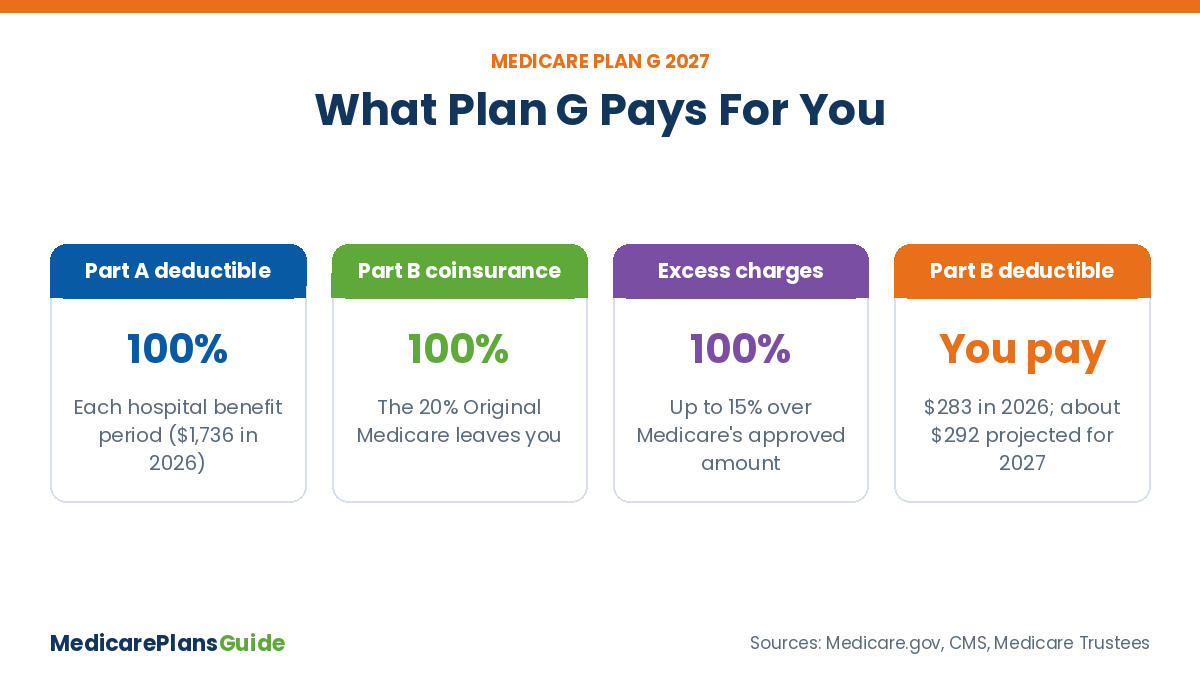
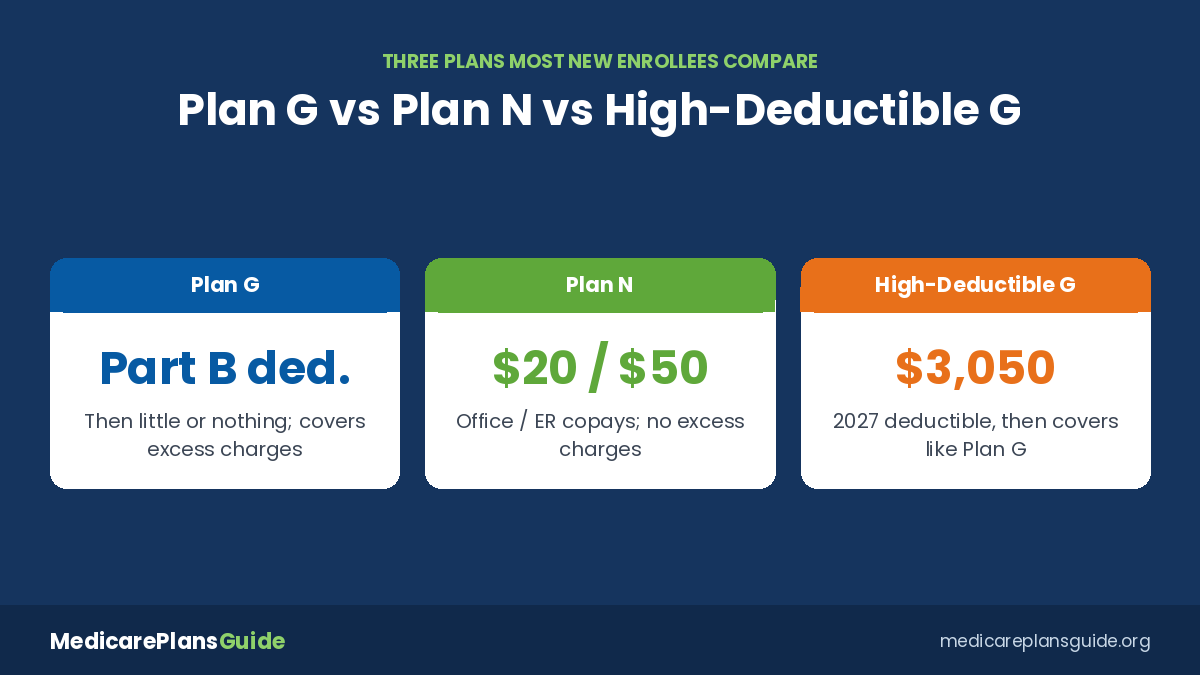
Plan F covers everything Plan G covers plus the Part B deductible. That single line, $283 in 2026 and $292 for 2027, is the only benefit difference between the two plans. Since January 1, 2020, Plan F cannot be sold to people new to Medicare, so for most shoppers today the real question is not which plan covers more, but whether Plan F’s higher premium is worth one deductible.
| What you pay out of pocket |
Plan F |
Plan G |
| Part B deductible (2026) |
$0 |
$283 |
| Part B deductible (2027) |
$0 |
$292 |
| Part A deductible, coinsurance, excess charges and everything else Medicare approves |
$0 |
$0 |
| Monthly premium |
Usually higher |
Usually lower |
| Who can buy it |
Only people eligible for Medicare before 2020 |
Anyone eligible for Medigap |
2026 and 2027 figures from CMS (2027 announced November 17, 2026).
Who can still buy Plan F
You can buy Plan F only if you were eligible for Medicare before January 1, 2020. That generally means you turned 65 before 2020, or qualified for Medicare earlier through disability or end-stage renal disease, even if you did not sign up at the time. If you first became eligible on or after January 1, 2020, Plan G is the most complete plan you can buy, and High-Deductible Plan G replaces High-Deductible Plan F.
Real Plan F and Plan G prices from one state guide
State insurance departments publish premium comparisons that show how the two plans are priced side by side. The Nevada Division of Insurance’s 2026 Medicare Supplement premium guide lists yearly premiums for a 65-year-old woman who does not smoke, in Las Vegas (ZIP 89102), from its September 2024 survey:
| Company |
Plan F (yearly) |
Plan G (yearly) |
Plan F costs more by |
| Washington National |
$2,821 |
$2,011 |
$810 |
| UnitedHealthcare |
$2,974 |
$2,326 |
$648 |
| State Farm |
$2,608 |
$2,072 |
$536 |
| USAA Life |
$2,388 |
$1,888 |
$500 |
| Cigna |
$2,200 |
$1,916 |
$284 |
Source: Nevada Division of Insurance, 2026 Medicare Supplement Insurance Premium Comparison Guide. The last column is our subtraction. Your rates depend on your age, ZIP code, tobacco use and company.
With the Part B deductible at $283, Plan F only pays you back $283 a year. At every company above, the extra Plan F premium was the same or more than that, so Plan G plus paying the deductible yourself came out even or ahead.
The quick test: subtract the Plan G premium from the Plan F premium for a full year. If the difference is more than the Part B deductible, Plan G costs you less overall, even after you pay the deductible yourself.
Why Plan F premiums keep climbing
No one new can join Plan F, so the group of people in it is getting older and using more care each year. KFF reports that people with Plan F paid an average of about $325 a month in 2025, compared with about $194 for Plan G. That gap is one reason many Plan F owners look at switching.
Switching from Plan F to Plan G
If you have Plan F and want Plan G’s lower premium, you can apply at any time, but in most states the new insurer can ask health questions and decline you outside a guaranteed issue situation. Some states give extra rights: California and Oregon, for example, give a yearly window around your birthday to move to a plan with equal or fewer benefits, which includes going from Plan F to Plan G.
Before you switch: keep your Plan F active until your Plan G is approved and in force, and compare the new premium with your Plan F premium plus the Part B deductible. Most Medigap policies also give you 30 days to review a new policy.