Medicare Part D Plans 2027

Medicare Part D plans in 2027 play an important role in helping seniors manage prescription costs and protect their health.

Plan rules, drug lists, and pricing are changing, which means the plan that worked for you last year may not be the best fit in the year ahead.

Understanding how Medicare Part D works, what is new for 2027, and how to compare options can help you keep your medications affordable and avoid unpleasant surprises at the pharmacy.

Medicare insurance specialists follow these updates closely and help Medicare beneficiaries match their prescriptions with the right coverage.

Below you will find a clear overview of Medicare Part D drug plans for 2027, written to help you make confident decisions and know when to ask for one-on-one help.

How Medicare Part D Plans Work in 2027

Medicare Part D is the part of Medicare that covers outpatient prescription medications. It is offered through private insurance companies that contract with Medicare.

You keep your original Medicare hospital and medical benefits, then add a separate Medicare prescription drug plan that focuses on medications.

Every Medicare Part D plan has a few basic features. First, each plan has its own list of covered drugs, called a formulary.

Drugs on that list are divided into cost tiers, with generics usually placed in lower, less expensive tiers and certain brand or specialty drugs in higher tiers.

Second, plans use a combination of premiums, deductibles, copays, and coinsurance to share costs with you. Finally, plans follow federal rules for the standard Part D benefit, including how you move through different coverage phases during the year.

In 2027, these basic rules still apply, but new legislation gives Medicare more power to negotiate drug prices, reshape catastrophic coverage, and bring greater transparency to formularies and plan designs.

These changes are intended to control drug costs for the program and provide extra savings for Medicare beneficiaries who rely on high-cost medications.

Because each insurance company designs its own Medicare Part D plans for 2027, no two plans look exactly alike. That is why it is important to compare more than the monthly premium.

The drugs that matter for your health, the pharmacies you prefer, and your comfort level with mail-order or specialty pharmacies all play a role in finding the right match.

What is Medicare Part D

Medicare Part D Plans : What Is Changing

Every year, Medicare Part D plans update their formularies, premiums, and cost structures. For 2027, several trends stand out.

Drug lists are being revised to account for newly available generics, updated treatment guidelines, and more attention to value based on real-world results.

Some drugs that were once difficult to afford may move to more favorable tiers, while others lose preferred status or require prior approval.

The biggest story for 2027 is Medicare’s expanded authority to negotiate drug prices with manufacturers.

High-impact medications used for conditions such as diabetes, heart disease, and certain cancers are now candidates for direct price negotiations.

The goal is to lower what Medicare pays and, in turn, reduce what you pay at the pharmacy.

Many of the top drugs targeted are brand-name products that previously created very high annual costs for people who rely on them.

Regulators are also tightening rules on how plans design their formularies. Plans must follow stricter standards for which drugs they include and how they place those drugs into tiers.

The intent is to make it easier to compare plans side by side, improve transparency, and prevent unreasonable barriers such as unnecessary step therapy or overly restrictive prior authorization for medications that doctors commonly prescribe.

Another important change affects how costs are spread throughout the year.

Adjustments to the catastrophic phase and refinement of earlier coverage stages are intended to smooth spending and reduce sharp jumps in out-of-pocket costs.

That means your spending pattern from January through December should become more predictable.

Seniors who have been frustrated by the traditional “donut hole” effect may notice a smoother experience with fewer sudden jumps in coinsurance.

All of these updates make it more important than ever to look at your Part D coverage every year during open enrollment.

Even if your plan name stays the same, the way it treats your drugs in 2027 may be different from the way it worked in 2026.


Medicare Part D Plans and State-by-State Differences

Medicare is a federal program, but Medicare Part D plans are offered by private insurers that design their plans for specific regions. As a result, Medicare beneficiaries in one state may see a very different list of available plans compared to their friends or relatives in another state.

These regional differences show up in several ways. Formularies vary, which means one plan in one state might cover a particular brand-name drug while a similar plan in another state prefers a different drug in the same class.

Negotiated prices also differ. The deal that an insurer has with a drug manufacturer in Florida may not match the agreement it has in Minnesota. That can lead to different pharmacy prices even when the plan names appear similar.

Pharmacy networks add another layer of variation. Many plans promote preferred pharmacy networks where you pay lower copays, and those preferred chains may be different in each state.

Home delivery options, specialty pharmacy partners, and local independent pharmacies can all influence your experience.

If you spend part of the year in another state, or if you plan to move, it is especially important to review how your medications would be covered in the new location.

A plan that works well in one state may not even be offered in another.

An experienced Medicare agent who works in all 50 states can help you compare your options before you move so your coverage and access to medications stay on track.

What Are Common Exclusions in Dental Plans?

What Medicare Part D Covers and How Drug Tiers Work

Medicare Part D prescription drug plans cover a broad range of outpatient medications, including many drugs used for chronic conditions like high blood pressure, diabetes, high cholesterol, and depression.

Plans must follow federal guidelines that require coverage of most drugs in certain protected classes, such as medications for cancer and HIV.

Beyond these requirements, each insurer builds its own formulary that lists the generic and brand-name medications it covers.

To organize costs, plans group drugs into tiers. Lower tiers typically include widely used generics with the smallest copays.

Middle tiers may hold preferred brand drugs with moderate copays, while higher tiers include non-preferred brands or specialty medications that come with higher coinsurance.

Where your medication falls on this ladder affects what you pay at the pharmacy.

In 2027, new rules on price negotiation and tier placement are encouraging plans to place more value on cost and clinical effectiveness.

That can mean expanded coverage of generics that provide similar results to high-priced brands, as well as closer attention to how drugs move between tiers from one year to the next.

Seniors who keep an eye on these shifts can often uncover opportunities for savings, either by switching plans or by working with their prescriber to move to an alternative drug in a lower tier.

Coverage is not unlimited. Some drugs require prior authorization, quantity limits, or step therapy, where you must try a lower-cost medication first. Understanding these rules before you enroll will help you avoid surprises when a doctor writes a new prescription.

How to Choose a Medicare Part D Plan for Your Prescriptions

Choosing a Medicare Part D plan is really about matching your current and expected medications with the plan that treats those drugs most favorably.

A sensible first step is to list every prescription you take, including strengths and how often you refill them. That list becomes your checklist while you compare plans.

When you review Medicare Part D plans for 2027, start by confirming that each medication appears on the plan’s formulary.

Next, look at which tiers your drugs fall into and what the copays or coinsurance amounts are for those tiers.

A plan with a slightly higher premium but stronger coverage for your most expensive medication can easily turn out to be the better value over a full year.

Star ratings from Medicare are another useful tool. These ratings measure factors such as customer service, member experience, safety measures, and overall plan performance.

Plans with higher star ratings have historically delivered more consistent service.

Also consider how each plan handles preferred pharmacies and mail-order options. If you like the convenience of prescriptions shipped to your door, check whether the plan offers special pricing for mail-order refills.

For people who strongly prefer a local pharmacy, it is wise to confirm that this location is in the network and, ideally, a preferred pharmacy.

Finally, think about how your health might change. If your doctor has mentioned the possibility of starting certain high-cost therapies, ask a licensed agent to run estimates for those drugs as well.

Planning ahead can prevent big jumps in spending if your treatment plan shifts during the year.

Common Mistakes When Choosing Part D

Many Medicare beneficiaries feel rushed during the fall open enrollment period and, as a result, repeat choices that no longer fit their needs. One of the most common mistakes is focusing only on the monthly premium.

A plan with a low premium but weak coverage for your prescriptions can cost far more in the long run than a plan with a slightly higher premium and stronger drug coverage.

Another frequent misstep is assuming that last year’s plan still works the same way. Formularies change every year.

A drug that used to be on a preferred tier might move to a more expensive tier or require prior authorization.

If you do not review your plan’s Annual Notice of Change, you may not realize the difference until you are standing at the pharmacy counter.

Ignoring pharmacy networks can also add unnecessary costs. Picking a plan that does not treat your favorite pharmacy as a preferred location may lead to higher copays on every refill.

Taking a few minutes to check which pharmacies receive preferred pricing can produce real savings over the course of a year.

Some people delay reviewing their coverage because they expect to have the same prescriptions next year. Health needs can change quickly, and new medications can be expensive.

Working with a licensed agent who understands how Part D plans handle new prescriptions can keep you better prepared for changes in your treatment plan.

Medicare Part D Late Enrollment Penalty Explained

Medicare encourages people to maintain continuous prescription drug coverage.

If you go for an extended period without creditable drug coverage after becoming eligible for Medicare, you may face a late enrollment penalty when you finally join a Part D plan.

The penalty is calculated based on how many full months you were eligible for Part D but did not have credible coverage, multiplied by a small percentage of the national base Part D premium.

The result is added to your monthly Part D premium and, in most cases, remains for as long as you stay enrolled in Medicare prescription drug coverage.

For example, if you wait several years after turning 65 to enroll and you did not have drug coverage that Medicare considers credible during that time, the penalty can become sizeable.

Many people are surprised to learn that this extra amount does not disappear after one year.

It continues year after year, which makes it especially important to understand and avoid it where possible.

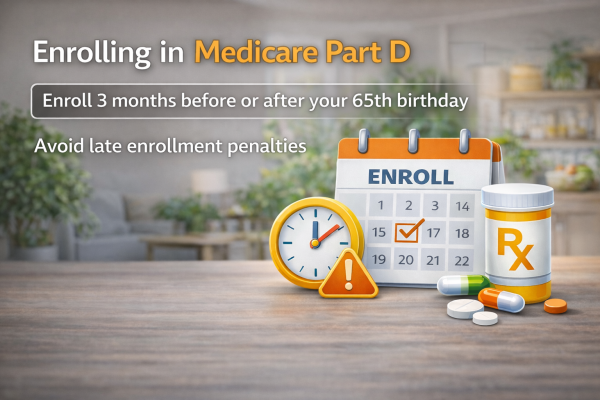
The best way to avoid the penalty is to enroll in a Medicare Part D plan during your Initial Enrollment Period or during a Special Enrollment Period if you had credible employer coverage that ends.

If you are unsure whether your current coverage is considered credible, a licensed Medicare specialist can review your situation and explain your choices before any penalty applies.

Steps to Enroll in a Medicare Part D Plan

Finding the Best Medicare Part D Plans for Your Budget

The “best” Medicare Part D plan is different for every person. For one individual, the right plan may focus on strong insulin coverage. For another, the priority may be specialty medications for a complex condition.

The winning plan is the one that covers your prescriptions at the lowest realistic cost while giving you access to the pharmacies and customer service you prefer.

A smart way to start is to compare several plans that look promising in your zip code.

Use the Medicare Plan Finder tool along with support from Medisupps to review estimated yearly drug costs, considering premiums, deductibles, and co-pays together.

Pay attention to how each plan handles the medications that drive most of your spending. Two plans may look similar on the surface, yet treat your most expensive drug very differently.

Look closely at negotiated prices as well. A plan with strong negotiation leverage may offer lower point-of-sale prices even before cost sharing.

This can make a difference for people who reach the catastrophic phase or who pay coinsurance instead of flat copays.

Service matters too. Consider whether the plan has a reputation for accurate billing, clear statements, and helpful phone support.

Plans with higher star ratings often perform well in these areas, which can spare you time and frustration when questions arise.

If you find the process overwhelming, you are not alone. Medicare Part D comparisons involve many moving parts.

Working with a licensed Medisupps advisor who is familiar with Medicare Part D plans for 2027 can make the process much easier and can help you uncover savings you might miss on your own.

What Medications Are Covered Under Medicare Formulary?

Get Help Comparing Medicare Part D Prescription Drug Plans

Medicare Part D plans in 2027 offer real opportunities for savings, especially with new rules on price negotiation and more transparent formularies.

At the same time, the growing number of choices and state-specific differences can make it challenging to feel confident that you have picked the plan that truly fits your needs.

You do not have to figure it out alone. Russell Noga and the Medisupps team review plan changes each year, track which companies provide strong value for common medications, and help Medicare beneficiaries compare options based on real-world pharmacy pricing.

If you would like personal help selecting a Medicare Part D plan for 2027, reach out to Medisupps for a free, no-obligation consultation.

Bring a list of your prescriptions and your preferred pharmacies, and a licensed specialist will walk you through your options, explain estimated costs, and point out ways to improve your savings and coverage.

You can request a free Part D comparison, schedule a call with an agent, or ask for a review of your current plan.

Taking a short amount of time now can give you confidence that your 2027 Medicare prescription drug coverage matches your health needs and your budget.

ZRN Health & Financial Services, LLC, a Texas limited liability company