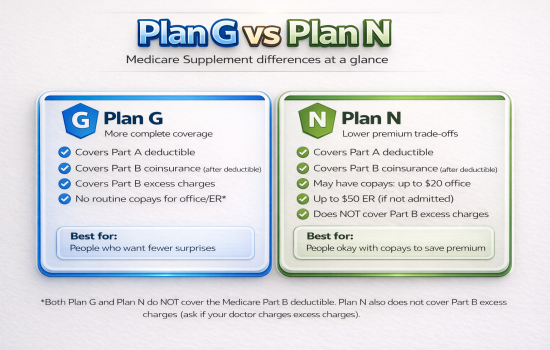
When evaluating Medicare supplement options, understanding the considerations for choosing between Plan G and Plan N is crucial. These considerations can significantly impact your financial stability and health security. Both plans are part of the Medigap offerings, designed to pick up where Original Medicare leaves off, ensuring seniors experience fewer out-of-pocket expenses for healthcare.
However, each plan caters differently to various priorities, from budget management to comprehensive coverage. It’s essential to align your Medicare supplement choice with your personal healthcare needs, budget, and preferences for provider flexibility. Plan G is often chosen for its extensive coverage.
It takes care of almost all Medicare-approved expenses after you meet the Part B deductible, providing peace of mind with minimal unexpected costs. This plan is particularly beneficial for those expecting to have frequent medical appointments or specialist visits, as it covers the Part A hospital coinsurance, Part B coinsurance or copayments, and even Part B excess charges.
Additionally, Plan G is advantageous for travelers, offering foreign emergency travel benefits, 80% coverage after a $250 deductible, up to $50,000 lifetime maximum. The predictable nature of Plan G makes it a solid pick for those valuing consistent coverage and avoiding surprise expenses. On the other hand, Plan N offers substantial savings on premiums by including copayments for certain services.
This structure appeals to beneficiaries who are relatively healthy and wish to keep monthly costs down. You’ll still get vital coverage for major expenses such as the Part A deductible and hospital coinsurance, but you’ll be responsible for up to $20 copayments for doctor visits and $50 for emergency room visits that don’t result in admission.
Importantly, Plan N does not cover Part B excess charges, which may occur if your provider charges more than Medicare’s approved amount, a factor to consider when budgeting for healthcare. Deciding between these plans involves weighing how often you anticipate needing medical services against potential savings on premiums.
Evaluate your annual healthcare utilization, considering if the higher upfront cost of Plan G covers the peace of mind knowing you won’t face many further charges beyond your Part B deductible. Alternatively, if you predict fewer healthcare needs, Plan N’s lower premium could offer greater annual savings, offsetting the out-of-pocket expenses from its copayment structure.
Both plans support Medicare beneficiaries by reducing the anxiety tied to unexpected medical costs, yet they do so in ways that cater to different needs and lifestyle preferences. Explore your Medicare options by entering your ZIP code on our site to compare plans.
Personalized help is available too when our contact number comes online. This insight empowers informed decisions about your Medicare supplement, fitting your unique health and financial landscape.
| Plan Aspect |
Plan G Features |
Plan N Features |
Best Fit For |
Additional Considerations |
| Coverage |
Covers most out-of-pocket costs, including Part B excess charges. |
Covers most out-of-pocket costs but excludes Part B excess charges, and co-payments for some services. |
Beneficiaries seeking comprehensive coverage. |
Consider the potential for higher premiums. |
| Out-of-Pocket Costs |
No co-pays or deductibles beyond the Part B deductible. |
Lower premiums, but includes co-pays and no coverage for Part B excess charges. |
Individuals are comfortable with lower premiums and occasional out-of-pocket costs. |
Assess frequency of doctor visits to calculate potential co-pays. |
| Premiums |
Generally higher due to more comprehensive coverage. |
Typically lower, making it more economically attractive. |
Cost-conscious individuals who occasionally use healthcare services. |
Compare various insurers for competitive rates. |
| Flexibility |
High: covers any provider accepting Medicare. |
Offers moderate provider flexibility; must be aware of potential charges not covered. |
Those prioritizing access to a wide range of providers. |
Review network policies to ensure preferred providers are accessible. |
This table succinctly outlines the distinctive features and ideal circumstances for selecting between Medicare Plan G and Plan N, aiding beneficiaries in making informed choices.
Deciding between Medicare Plan G and Plan N depends on your needs and budget. Both offer strong coverage, but differ in out-of-pocket costs and network flexibility. Take time to review each option to find what suits you best.
To explore your choices further, enter your ZIP code on our site and compare Medicare options available in your area from different companies. These include companies like Florida Blue, Aetna, Cigna, Mutual of Omaha, and more. If you need personalized assistance, you can also call us once our phone number is available. We’re here to help you make an informed and confident decision about your Medicare coverage.